How to Invest in Gold in Pakistan
From Sarafa markets to digital schemes – everything you need to protect your wealth against inflation and rupee depreciation.
Gold remains one of the most popular wealth protection assets in Pakistan because it helps protect savings against inflation and rupee depreciation. For pure investment, 24K gold bars and coins are generally preferred because they have higher purity and better resale value.
For many families, learning how to invest in gold in Pakistan is an important part of protecting savings against inflation and rupee depreciation. Whether you choose gold bars, jewellery, or savings schemes, gold investment in Pakistan remains one of the most trusted long-term wealth strategies.
Portfolio allocation visualiser
Drag the slider to set your gold allocation and see how a balanced portfolio might look.
Is Gold a Safe Investment in Pakistan in 2026?
Pakistan’s economy faces recurring challenges,inflation regularly runs in double digits, the rupee depreciates against the dollar and bank deposit rates often fail to keep up with the rising cost of living. In this environment, gold performs a job that few other assets can.
According to the World Gold Council, gold continues to be one of the most trusted assets during periods of inflation and currency weakness. Investors can also monitor exchange rate trends through the State Bank of Pakistan before purchasing gold.
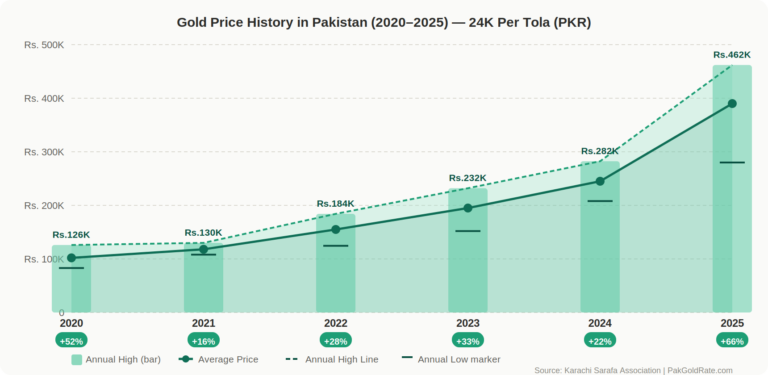
Over the last decade, the gold price in Pakistan has gone from roughly Rs. 60,000 per tola to over Rs. 500,000 per tola a gain of more than 700%. Even accounting for inflation, that is a dramatic preservation of purchasing power, and a major reason so many Pakistanis choose to invest in gold in Pakistan over other asset classes.
Gold works here for three reasons:
1. Hedge Against Rupee Depreciation
Every time the USD/PKR rate rises, so does the gold price in Pakistan. Since gold is priced globally in US dollars, Pakistani investors who hold gold automatically protect themselves when the rupee weakens, which is one of the clearest reasons to invest in gold in Pakistan right now.
2. Inflation Protection
When essentials get more expensive, gold tends to rise in value too. Historically, gold in Pakistan has outpaced the Consumer Price Index (CPI) over multi-year periods, reinforcing why many choose to invest in gold in Pakistan as a long-term hedge.
3. Emergency Liquidity
Unlike real estate, gold can be sold quickly. Whether at a Sarafa market, a jeweller, or a gold bank,turning gold into cash takes hours, not months which adds to the appeal of choosing to invest in gold in Pakistan.
Understanding Gold Prices in Pakistan Before You Buy
Before investing, you must understand how gold is priced here:
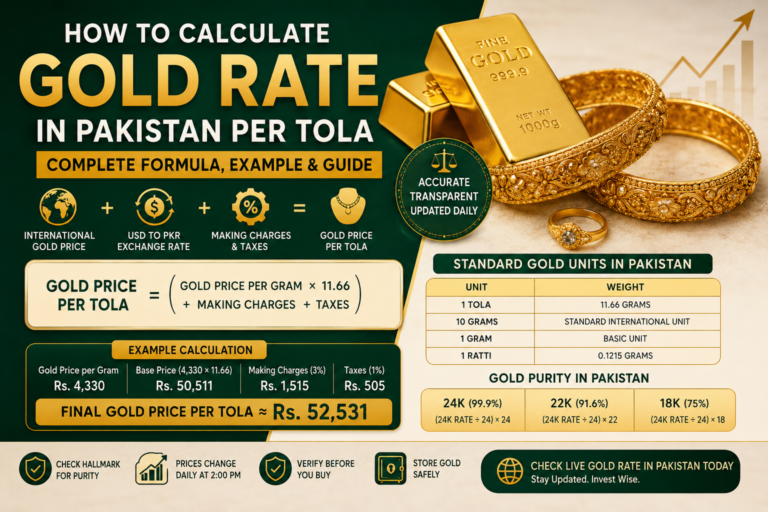
Gold Units Used in Pakistan
- 1 Tola = 11.664 grams (the standard unit in Pakistan)
- 10 Grams = a common benchmark for gold bars
- 1 Gram = for smaller purchases or jewellery
Understanding these units is essential before you invest in gold in Pakistan because local dealers local dealers quote in tola while international prices use troy ounces, a key detail before you invest in gold in Pakistan.
Gold Purity (Karat) Guide
| Karat | Purity | Common Use in Pakistan |
|---|---|---|
| 24K | 99.9% | Gold bars, bullion investment |
| 22K | 91.6% | Most common for jewellery |
| 21K | 87.5% | Jewellery, common in KPK |
| 18K | 75% | Modern jewellery, watches |
For investment purposes, always target 24K gold it is the purest and commands the best resale price. For jewellery that doubles as an investment, 22K is the Pakistani standard.
Where Gold Prices Come From
The gold rate in Pakistan is set daily based on two factors:
- International spot price (London/New York gold market, in USD per troy ounce)
- USD to PKR exchange rate (published by the State Bank of Pakistan)
The Karachi Sarafa Association announces the official daily rate each morning, which jewellers and bullion dealers across Pakistan follow.
Tip: Always check the current gold rate on PakGoldRate.com before making any purchase. A difference of even even Rs. 500 per gram matters when buying multiple tolas, especially if you plan to invest in gold in Pakistan regularly.
Best Ways to Invest in Gold in Pakistan
Here are the five most practical ways to invest in gold in Pakistan, ranked from most to least straightforward for everyday buyers.
1. Physical Gold (Bars and Coins) Best for Pure Investment
Buying gold bars or coins is the cleanest form of gold investment. You own actual gold, there are no third-party risks and resale is straightforward.
For most investors, physical gold bars and coins remain the preferred option because they offer direct ownership and easier resale value.
Where to buy:
- Karachi Sarafa Market (most competitive prices)
- Lahore’s Anarkali and Urdu Bazaar gold markets
- Licensed bullion dealers in Islamabad and other major cities
- Banks like HBL and MCB that offer gold coin sales
Tips for Buying Gold Bars and Coins in Pakistan:
- Always ask for a purity certificate or hallmark stamp
- Weigh the gold yourself before payment
- Keep the receipt it protects resale value
- Store in a bank locker, not at home, if buying more than 2–3 tolas
Pros: Full ownership, no counterparty risk, easy to liquidate
Cons: Storage cost, no passive income, risk of theft but for most people looking to invest in gold in Pakistan this remains the preferred starting point.
💰 Calculate your gold purchase
2. Gold Jewellery , Investment With Utility
Most Pakistani families invest in gold through jewellery especially at weddings. This is not the most efficient investment form, but it is widely accessible.
The problem with jewellery as investment: When you buy gold jewellery, you pay the gold weight price plus making charges (ujrat), which can range from Rs. 3,000 to Rs. 10,000 per tola depending on design complexity. When you sell, the jeweller pays you only for the gold weight, not the making charges so you immediately lose that amount.
How to minimise losses on jewellery investment:
- Choose simple, heavy designs with minimal making charges
- Always buy 22K hallmarked jewellery from reputable shops
- Get a written receipt mentioning weight and karat
- Avoid stone-set pieces , stones add weight to the receipt but zero value at resale, which is why jewellery is rarely the most efficient way to invest in gold in Pakistan.
3. Jewellery Savings Schemes (Monthly Installment Plans)
Many jewellers in Pakistan offer gold saving schemes where you deposit a fixed monthly amount for 11 months and receive jewellery worth 12 months of deposits. Effectively, the jeweller gives you one free month as a bonus.
Examples: Al-Fatah Gold Scheme, Meena Bazaar Gold Saving Plan and many local jeweller-run schemes.
Pros: Forces regular saving habit, accessible with small monthly amounts (Rs. 5,000–20,000)
Cons: Risk tied to the jeweller’s solvency, you receive jewellery not cash, making charges still apply
Who is it for: People who struggle to save lump sums and want to accumulate gold gradually as a simple way to invest in gold in Pakistan over time.
4. Gold ETFs and Digital Gold
Pakistan is slowly opening up to digital gold investment through fintech platforms. While a direct gold ETF listed on the Pakistan Stock Exchange (PSX) is not yet widely available to retail investors as of 2025, a few emerging options exist:
- Roshan Digital Account (RDA): Overseas Pakistanis can invest in Pakistan’s National Savings schemes, some of which are inflation-linked
- Fintech apps: Some emerging platforms are exploring commodity-backed digital gold, though regulation is still developing
- International gold ETFs via brokerage: Advanced investors with access to international brokerage accounts can buy gold ETFs like GLD or IAU
Verdict for most Pakistanis: Physical gold remains the most practical and accessible form of investment for now.Watch this space as SECP regulation around digital commodities matures, since this could eventually change how people invest in gold in Pakistan.
5. Gold Loans and Financing ,Using Gold You Already Own
If you already own gold but need cash, gold loans are an excellent option. Rather than selling your gold at current prices, you pledge it as collateral and borrow against it.
Where to Get Gold Loans in Pakistan:
- HBL Gold Financing
- NBP Gold Loan
- Meezan Bank (Islamic gold financing under Qard-based model)
- Local Sarafa dealers who offer informal lending
This allows you to access liquidity without losing your gold investment especially useful if you believe gold prices will rise further, without giving up your existing decision to invest in gold in Pakistan.
How Much Should You Invest in Gold in Pakistan?
Financial advisors generally suggest a portfolio allocation based on your risk tolerance:
| Investor Profile | Suggested Gold Allocation |
| Conservative (salaried, stable income) | 20–30% of savings |
| Balanced (business owner, moderate risk) | 15–20% of savings |
| Growth-focused (younger investor) | 10–15% of savings |
For most Pakistani middle-class families, keeping 20–25% of savings in physical gold is a reasonable hedge against inflation and currency risk for most people choosing to invest in gold in Pakistan.
Best Time to Invest in Gold in Pakistan
Timing gold purchases is difficult, even for professional investors. However, a few practical observations apply in the Pakistani context:
- Buy when international gold prices dip : watch the USD spot price daily on PakGoldRate.com
- Avoid buying right before wedding season (October–January) when local demand spikes and dealers charge premiums
- Buy when PKR is relatively strong against the dollar your rupees will buy more gold
- Dollar-cost averaging : buying a fixed rupee amount of gold each month removes timing stress entirely and is the approach most long-term investors recommend.
- Avoid Emotional Buying : Do not buy because news headlines are everywhere,prices suddenly jump,everyone is buying Instead follow price trend,buy gradually and maintain a long-term view.
Many experienced investors buy gradually instead of waiting for the perfect price. Monthly buying reduces risk and helps build long-term wealth consistently.
Good times to buy
When USD spot price dips internationally. When PKR is relatively strong. Between February and September / off wedding season.
Approach with caution
During political or global uncertainty / prices spike but can correct sharply. After a long bull run. If you need cash within 12 months.
Avoid these moments
Right before wedding season (October–January) / dealers charge premiums. Never buy in panic after media hype about gold prices.
Risks to Know Before Investing in Gold
Gold is not risk-free. Here are the key risks for Pakistani investors:
1. Price Volatility:
Gold can fall 10–15% in short periods if global risk sentiment improves or the rupee strengthens suddenly.
2. No Yield:
Gold pays no dividend, no rent, no interest. It only gains value if prices rise.
3. Counterfeit Risk:
Fake gold is a real issue in Pakistan. Always buy from established Sarafa dealers or hallmarked shops, and always verify purity.
4. Storage and Security:
Physical gold requires secure storage. Bank lockers cost Rs. 3,000–10,000 annually but are well worth it.
5. Making Charge Loss on Jewellery:
As discussed, jewellery is the least efficient investment form due to non-recoverable making charges.
Price volatility
Gold can fall 10–15% in short periods if global risk sentiment improves or the rupee strengthens suddenly.
No yield
Gold pays no dividend, no rent, no interest. It only gains value if prices rise / not suitable as your only investment.
Counterfeit risk
Fake gold is a real issue in Pakistan. Always buy from established Sarafa dealers or hallmarked shops and verify purity yourself.
Storage & security
Physical gold requires secure storage. Bank lockers cost Rs. 3,000–10,000 annually / never store large quantities at home.
Making charges on jewellery
Making charges of Rs. 3,000–10,000 per tola are non-recoverable at resale / the least efficient form of gold investment.
Scheme / fintech solvency
Jeweller-run savings schemes and fintech platforms carry solvency risk. Stick to regulated institutions or established Sarafa members.
Quick Tips Summary
- Buy 24K gold bars or coins for pure investment / best purity, best resale price.
- Always buy from Sarafa-registered dealers or hallmark-certified shops / never from unknown vendors.
- Check the live gold rate on PakGoldRate.com before every purchase / even Rs. 500/gram matters across multiple tolas.
- Get a written receipt with exact weight, karat, and price / protects resale value and prevents disputes.
- Store gold in a bank locker, not at home, if buying more than 2–3 tolas.
- Use dollar-cost averaging / buy a fixed rupee amount monthly for consistent, stress-free accumulation.
- Consider a gold loan before selling if you need short-term cash / keep your position intact.
- Avoid heavy making-charge jewellery for investment / choose simple, heavy 22K hallmarked pieces only.
- Weigh the gold yourself before payment / use a trusted scale at the dealer’s counter.
- Gold investment in Pakistan should form 20–25% of savings / not your entire wealth.
Frequently Asked Questions
Q: What is the minimum amount needed to invest in gold in Pakistan?
You can start with as little as 1 gram of gold (approximately Rs. 43,000–45,000 at current 2025 prices). Many jewellers sell fractional pieces. However, for pure investment purposes, 1 tola is the most common minimum practical unit.
Q: Is buying gold from a jeweller safe in Pakistan?
It is safe if you buy from a registered Sarafa Market member or a hallmark-certified shop. Always verify the karat purity stamp (hallmark), weigh the gold yourself, and get a signed receipt with weight and price details.
Is gold halal to invest in?
Yes. Islamic scholars consider gold a permissible (halal) investment in its physical form. Gold savings schemes that are structured as advance payment for future gold (salaam contracts) are also generally considered permissible. However, gold-based financial derivatives or margin trading are considered impermissible under most scholarly opinions.
Can I invest in gold online in Pakistan?
Fully regulated online gold investment is still limited in Pakistan as of 2025. Some fintech platforms are exploring digital gold products, but physical gold through established Sarafa dealers remains the most reliable and widely used method.
What is the safest way to invest in gold in Pakistan?
For most investors, the safest way to invest in gold in Pakistan is through certified 24K gold bars or coins purchased from reputable Sarafa dealers or banks.
How much gold should a beginner buy?
Start according to your budget and avoid investing money needed for short-term expenses.
Should I buy gold bars or jewellery?
For investment, bars and coins are usually more efficient because jewellery includes making charges.
Conclusion
Making smart gold purchases does not have to be complicated understanding your purpose, verifying purity and buying at fair prices is all it takes to build lasting wealth. For most Pakistanis, a combination of physical gold bars for savings and 22K jewellery for cultural and practical use represents a balanced approach.
The most important habit? Check the live gold rate before every purchase. Prices change daily and even small differences add up over multiple tolas. Bookmark PakGoldRate.com for daily updates on gold prices across all cities in Pakistan.Whether you’re just starting out or refining an existing strategy, the fundamentals of how to invest in gold in Pakistan stay the same, buy with purpose, verify purity and track prices daily.
Updated: May 2025 | Source: Karachi Sarafa Association, State Bank of Pakistan